
We build the space between HR policy and manager behavior when it comes to parental leave.
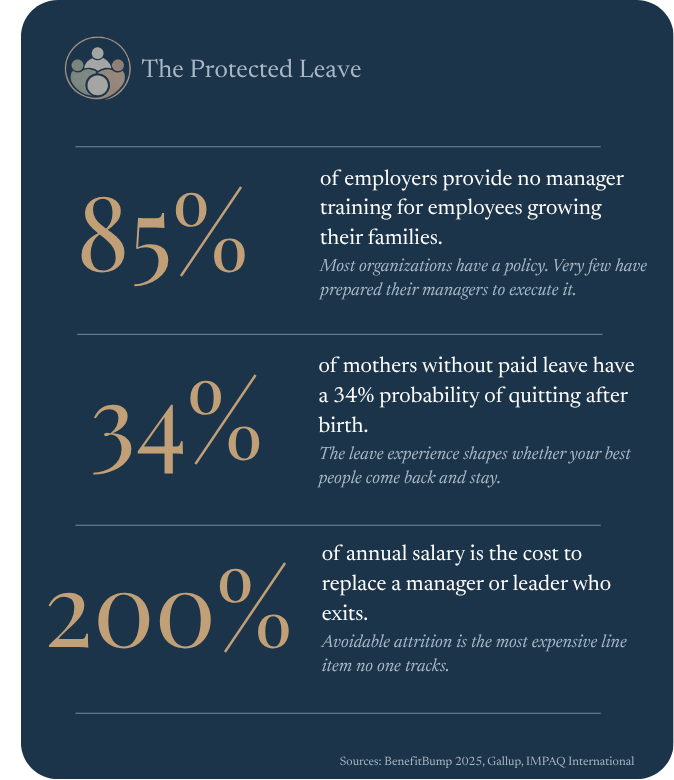
You can name the resignation you didn't see coming, the manager who made a legally sensitive decision without knowing it was one, and the employee who came back from leave, left six months later, and told their network exactly why.
What's harder to name is the pattern underneath those incidents, which is that your people managers have never been given an organizational standard for how to handle parental leave. The Protected Leave builds that standard through training, practical tools, and manager protocols your HR team owns and can enforce.
HRCI Recertification Provider · Approved 2026 · HR credit hours toward PHR, SPHR, and related certifications
The Protected Leave offers facilitated training for managers and professional development for HR leaders, all built around one problem, the gap between parental leave policy and what managers actually do.
When there is no organizational standard guiding manager behavior, what happens during the parental leave lifecycle depends entirely on who the manager is, and that inconsistency creates exposure across every stage.
The Gap
Benefits exist
Paid leave is already in place
Most employers have invested in parental leave benefits, but the day-to-day manager experience is still uneven across teams.
Execution does not
Managers are still improvising
Without a defined process, disclosure conversations, role protection, leave management, and reintegration all vary by manager.
HR pays later
Issues surface downstream
By the time HR sees the escalation, the problem usually started much earlier, in a manager decision or conversation that was never guided by a standard.
Our Services
The organizational standard your parental leave policy has always needed.
for HR Leaders
facilitated training
The HR Leaders Build Session: Closing the Execution Gap
This is the infrastructure work that parental leave policy alone cannot do, and it produces something HR can report upward and stand behind.
What this session covers:
In a facilitated cohort of up to ten HR leaders, you will assess exactly where your organization's execution gap lives across the full leave lifecycle and identify and start to build the four structural components HR can own and implement without waiting on headcount, budget approval, or a major initiative to get started.
What HR Walks away with:
Every participant receives the Leave Behind Guide, a framework-driven resource covering how to build each component and how to measure whether it is working, structured so you can act on it independently when you return to your desk. You will also leave with a five-stage assessment of your current manager standard, four buildable infrastructure components, and three readiness questions for the leadership conversation required to close the gap.
Most HR leaders can describe their parental leave policy in detail. What very few can describe is the standard governing how their people managers execute it, because in most organizations, that standard does not exist. Managers operate on instinct, outcomes vary, and HR is responsible for results it has no mechanism to control. Let’s fix that.
live webinar
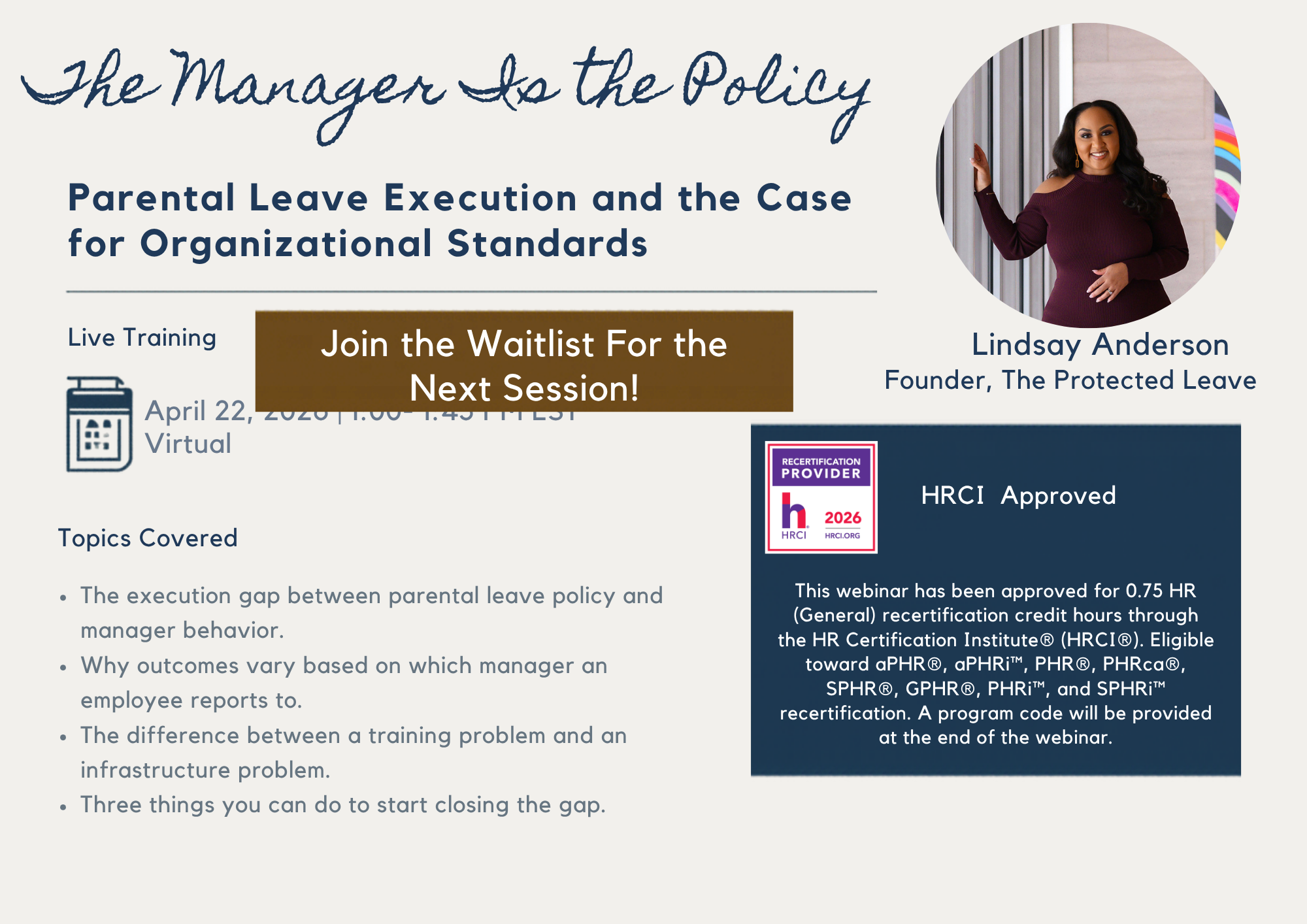
“This session was very insightful and informative. I walked away learning several new facts and appreciated the engaging way the information was presented.”
— 4/22/26 Webinar Participant
“The session helped me understand the importance of having standards for parental leave.”
— 4/22/26 Webinar Participant
How the standard gets implemented at the manager level.
for your People managers
facilitated training
The Parental Leave People Manager Training
For organizations that have built the HR-side standard and are ready to equip their manager population directly. All engagements are facilitator-led cohort sessions. Managers leave with practical tools and frameworks to execute your parental leave policy consistently at every stage of the lifecycle.
What this session covers:
This is a facilitator-led cohort session covering the full parental leave lifecycle, from the moment an employee discloses through the first 90 days after they return. Managers leave with structured decision frameworks, documentation practices, and a clear process for each stage of the lifecycle.
What HR owns:
HR commissions this engagement and owns what it produces. The standard your organization built is what managers are trained to carry out, so the training is an extension of the infrastructure HR already controls. Each cohort is capped at 20 managers. Discovery call required.
Most people managers know their organization has a parental leave policy. What very few have ever been given is a standard for how to carry it out, which means every disclosure conversation, every handoff, every re-entry is handled differently depending on who the manager is. This session changes that.
The Protected Leave On Retainer
ongoing support
how it works
This is a fractional arrangement structured around the moments that matter. A base retainer covers ongoing availability and quarterly infrastructure reviews, keeping your manager standard current as programs like FAMLI expand and the landscape around parental and family leave continues to shift. When a specific moment occurs, a regulatory or organizational change that requires the standard to be updated, a large cohort of employees going on leave, or a group of managers who need to be trained or retrained, that work is scoped and engaged directly.
What you get:
You get the operational expertise of a dedicated leave infrastructure resource without the headcount cost of one. Discovery call required. Engagements are limited to two to three organizations at a time.
Most organizations know they need someone who owns the parental leave infrastructure layer, keeps the manager standard current as the organization evolves, and steps in to build or rebuild when something changes. What most organizations cannot justify is a full-time hire to do it.
When parental leave goes well, HR should get credit for it.
What HR can prove
Right now, when a leave transition goes smoothly, there's no paper trail that says HR built something that made that happen. When it goes badly, HR gets the escalation. This system changes that. Every engagement builds a documented, trackable record HR can report upward.
What we measure together at 90 days
Manager protocol completion rate
HR escalations related to parental leave
90-day post-return retention of leave-takers
How it works
How engagements are delivered
2
Build
Put the organizational standard in place, whether that starts with HR infrastructure, manager training, or both.
1
Identify
Find where inconsistency is creating exposure in your organization's parental leave lifecycle.
4
Prove
HR has a documented record of consistent, traceable execution it can report upward and stand behind.
3
Execute
Managers follow defined decision points and documentation practices at every stage of leave.
Designed to require minimal lift from HR.
free diagnostic tool
Not sure where your gaps are?
Most HR leaders can identify a problem after it surfaces. This assessment helps you find it before it does. The free 10-point Parental Leave Risk Assessment takes five minutes and gives you a risk score you can act on and share with your leadership team.
See where your current process is most vulnerable.
Identify whether the gap is in policy, process, or manager execution.
Get a practical starting point your organization can act on.
Get Your Risk Score
common questions
What HR Leaders Want to Know
-
No, and that is intentional. I am a former people manager with nearly a decade of experience leading teams through parental leave transitions in an organization where I also went on leave myself. I build operational systems that prevent the manager behaviors that create compliance problems. I teach what works at the manager level in real conversations, not just what the law says in theory.
For specific legal questions about your organization’s obligations under PWFA, the PUMP Act, FMLA, or state laws, I will always refer you to qualified employment counsel. My role is to reduce the situations that require that conversation in the first place.
Nothing in The Protected Leave™ materials, training sessions, or assessments constitutes legal advice. Organizations should consult qualified employment counsel for guidance specific to their circumstances.
-
HR designs policy and ensures compliance at the organizational level. Managers make the day to day execution decisions.
Most organizations assume managers know how to handle leave transitions because policies exist. In practice, many managers are navigating these conversations for the first time. This training supports HR by giving managers structure so HR is not pulled in after a problem has already escalated.
-
Engagements are cohort based and interactive. Sessions are delivered live, virtually or in person, depending on your needs. Modules typically range from 45 to 90 minutes and include practical application, discussion, and scenario work so managers can practice the frameworks rather than passively receive information.
Cohort size is intentionally limited to preserve discussion quality and ensure managers can apply what they learn.
-
Strong policies still require strong execution.
We do not rewrite your policies. We build the operational layer that helps managers carry them out consistently. The gap between what is written and what happens in a manager’s first conversation is where resignations, complaints, and performance disruption often begin. That is the gap we address.
-
Even a small number of transitions can have outsized impact.
If one return goes poorly, the cost of replacement, disruption, and lost productivity can exceed the investment in building a consistent framework. The systems developed in this training also apply to other protected leave events, not just parental leave, which increases the return over time.
-
Most compliance training focuses on awareness. Managers learn what not to say and what laws apply.
This training focuses on execution. Managers receive specific scripts, structured frameworks, and decision tools for disclosure, leave management, reintegration, and post leave performance calibration. The difference is not knowledge, but operational structure.
-
The frameworks are consistent, but the examples, toolkit language, benefit mapping, and manager tools are tailored to your organization. Managers receive materials aligned to your policies, your benefits structure, and your operating reality rather than generic scenarios.
-
This engagement is most impactful in organizations where managers independently oversee performance and workload decisions and where parental or protected leave events occur regularly enough to require consistent handling.
It is particularly valuable in mid sized and enterprise environments where inconsistent execution across departments creates uneven employee experiences.
-
Organizations typically see:
More consistent disclosure conversations
Fewer informal arrangements during leave
Structured and documented re entry plans
Reduced post leave attrition
Fewer reactive escalations to HR
Stronger documentation practices during the first 90 days post return
The goal is not simply compliance awareness. It is consistent execution.